Introduction
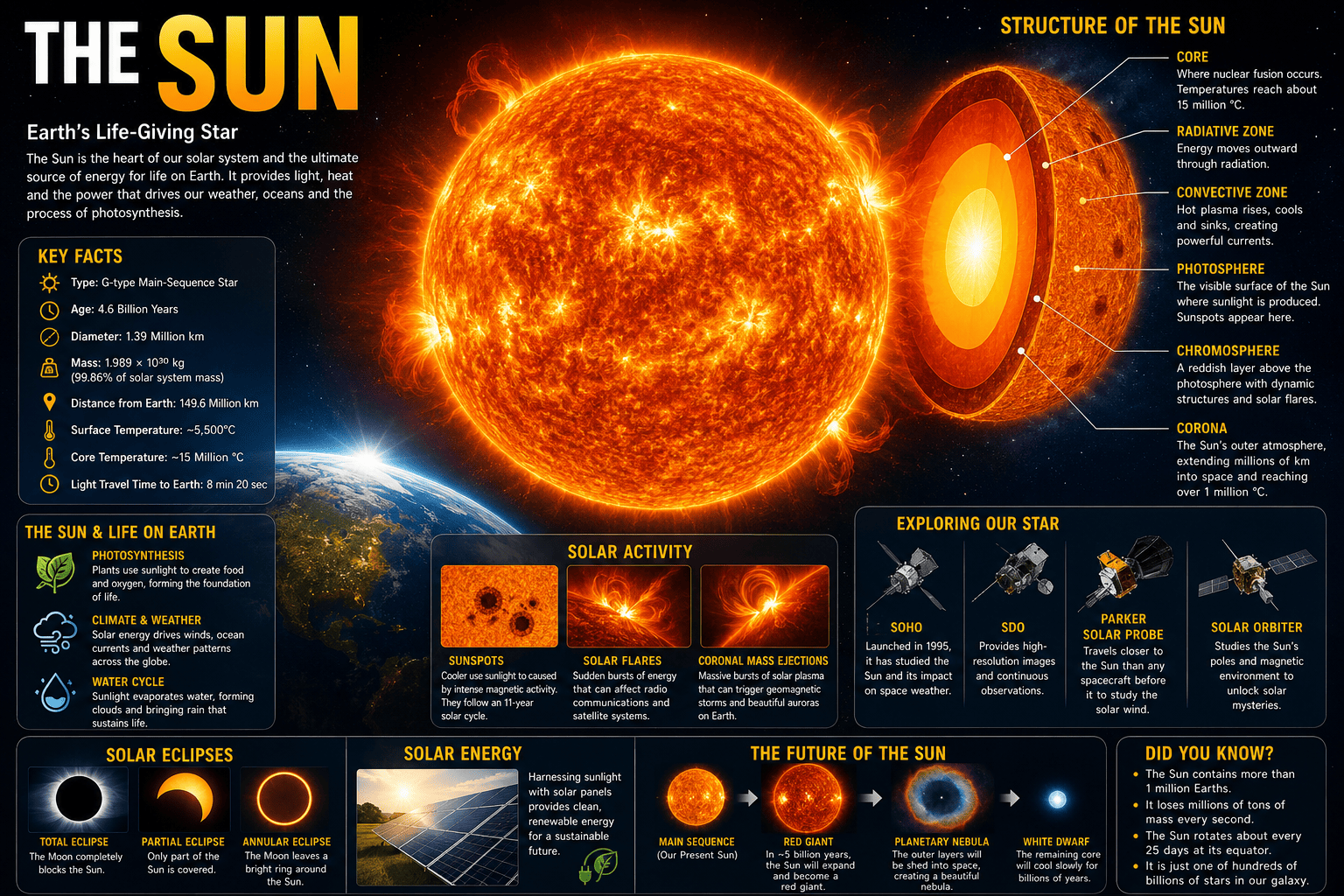
The Sun is the center of our solar system and the most important source of energy for life on Earth. Without it, our planet would be a frozen, dark world incapable of supporting plants, animals, or humans. For billions of years, the Sun has provided light, warmth, and the energy that drives weather patterns, ocean currents, and the process of photosynthesis.
Despite being one of hundreds of billions of stars in the Milky Way galaxy, the Sun is unique to us because it is our closest star. It influences every aspect of life on Earth and continues to be a subject of scientific study. Understanding the Sun helps scientists learn not only about our own solar system but also about stars throughout the universe.
This article explores the Sun’s formation, structure, characteristics, importance, and future.
What Is the Sun?
The Sun is a massive sphere of hot plasma composed primarily of hydrogen and helium. It contains approximately 99.86% of all the mass in the solar system. Every planet, moon, asteroid, and comet orbits around it due to its immense gravitational pull.
The Sun is classified as a G-type main-sequence star, often called a “yellow dwarf.” However, it is neither particularly yellow nor especially small compared to many other stars. Its classification simply places it within a specific category based on its temperature and spectral characteristics.
Located about 149.6 million kilometers (93 million miles) from Earth, the Sun provides the perfect amount of energy needed to sustain life on our planet.
Formation of the Sun
Scientists believe the Sun formed approximately 4.6 billion years ago from a giant cloud of gas and dust known as a molecular cloud.
The process began when gravity caused part of this cloud to collapse inward. As the material condensed, it formed a spinning disk called a solar nebula. Most of the mass gathered at the center, creating a protostar that would eventually become the Sun.
As pressure and temperature increased in the core, hydrogen atoms began fusing into helium through nuclear fusion. This process released enormous amounts of energy and marked the birth of the Sun as a true star.
The remaining material in the solar nebula gradually formed the planets, moons, asteroids, and other objects that make up our solar system today.
Physical Characteristics
The Sun is enormous compared to Earth.
Some key statistics include:
| Characteristic | Value |
|---|---|
| Diameter | 1.39 million km |
| Radius | 696,340 km |
| Mass | 1.989 × 10³⁰ kg |
| Surface Temperature | About 5,500°C |
| Core Temperature | About 15 million°C |
| Age | Approximately 4.6 billion years |
| Distance from Earth | 149.6 million km |
More than one million Earths could fit inside the Sun’s volume. Its gravitational influence extends far beyond the orbit of Pluto and governs the motion of all objects in the solar system.
Structure of the Sun
The Sun consists of several distinct layers, each with unique properties.
Core
The core is the central region where nuclear fusion occurs. Temperatures reach approximately 15 million degrees Celsius, and pressure is so intense that hydrogen nuclei combine to form helium.
This fusion process releases gamma rays and vast amounts of energy. Every second, the Sun converts about 600 million tons of hydrogen into helium.
Radiative Zone
Surrounding the core is the radiative zone. In this region, energy moves outward through radiation.
Photons generated in the core repeatedly collide with particles, causing them to take thousands or even millions of years to reach the next layer.
Convective Zone
Above the radiative zone lies the convective zone.
Here, hot plasma rises toward the surface, cools, and then sinks back down. This creates convection currents similar to boiling water in a pot.
These motions contribute to the Sun’s magnetic activity and surface features.
Photosphere
The photosphere is the visible surface of the Sun.
Although it appears solid, it is actually a layer of glowing plasma approximately 500 kilometers thick. Most sunlight originates from this region.
Sunspots, dark areas caused by intense magnetic activity, are visible here.
Chromosphere
Above the photosphere lies the chromosphere.
This layer appears reddish during solar eclipses and contains dynamic structures such as spicules and solar flares.
Corona
The corona is the Sun’s outer atmosphere.
It extends millions of kilometers into space and surprisingly reaches temperatures of over one million degrees Celsius, much hotter than the surface below.
Scientists continue to investigate why the corona is so hot.
Nuclear Fusion: The Sun’s Power Source
The Sun produces energy through nuclear fusion.
Inside the core, hydrogen nuclei move at extremely high speeds due to intense heat and pressure. When they collide, they fuse together to form helium.
This process releases energy according to Albert Einstein’s famous equation:
E = mc²
A tiny amount of mass is converted into enormous quantities of energy.
Every second, the Sun releases approximately:
- 384.6 septillion watts of power
- Enough energy to meet humanity’s needs for millions of years
- Vast quantities of light, heat, and radiation
This energy travels through space and reaches Earth in about eight minutes and twenty seconds.
The Sun and Life on Earth
Life on Earth depends entirely on solar energy.
Photosynthesis
Plants use sunlight to convert carbon dioxide and water into glucose and oxygen through photosynthesis.
Without sunlight:
- Plants could not grow
- Food chains would collapse
- Oxygen production would cease
Virtually all ecosystems ultimately rely on solar energy.
Climate and Weather
The Sun drives Earth’s weather systems.
Uneven heating of the atmosphere causes:
- Winds
- Ocean currents
- Storms
- Seasonal changes
Climate patterns across the globe are influenced by the amount of solar energy received at different latitudes.
Water Cycle
The Sun powers the water cycle by evaporating water from oceans, lakes, and rivers.
This leads to:
- Cloud formation
- Rainfall
- Snow
- Groundwater replenishment
Without solar energy, the water cycle would stop.
Solar Activity
The Sun is far from a calm, unchanging object.
Its magnetic field produces various forms of activity.
Sunspots
Sunspots are darker, cooler regions on the Sun’s surface.
They occur where magnetic fields are particularly strong and can be larger than Earth.
The number of sunspots rises and falls during an approximately 11-year solar cycle.
Solar Flares
Solar flares are sudden explosions of energy.
They can release radiation across the electromagnetic spectrum and affect communication systems on Earth.
Large flares may disrupt:
- Radio communications
- GPS signals
- Satellite operations
Coronal Mass Ejections
Coronal mass ejections (CMEs) involve the release of billions of tons of solar plasma into space.
When directed toward Earth, they can trigger geomagnetic storms.
Potential effects include:
- Aurora displays
- Satellite damage
- Power grid disruptions
- Increased radiation exposure for astronauts
Solar Eclipses
A solar eclipse occurs when the Moon passes between Earth and the Sun.
There are several types:
Total Solar Eclipse
The Moon completely blocks the Sun’s disk.
Observers can see the Sun’s corona, creating one of nature’s most spectacular sights.
Partial Solar Eclipse
Only part of the Sun is covered.
Annular Solar Eclipse
The Moon appears slightly smaller than the Sun, leaving a bright ring around it.
Solar eclipses provide scientists with valuable opportunities to study the Sun’s outer atmosphere.
The Sun in Human History
Throughout history, civilizations have revered the Sun.
Ancient cultures often worshipped solar deities.
Examples include:
- Ra in ancient Egypt
- Helios in ancient Greece
- Surya in Hindu traditions
- Inti in the Inca Empire
The Sun played a central role in calendars, agriculture, navigation, and religious practices.
Many monuments, including Stonehenge and various pyramids, align with solar events such as solstices and equinoxes.
Scientific Exploration of the Sun
Modern science has greatly expanded our understanding of the Sun.
Important solar observatories and missions include:
Solar and Heliospheric Observatory (SOHO)
Launched in 1995, SOHO has provided valuable insights into solar structure and activity.
Solar Dynamics Observatory (SDO)
This mission continuously monitors the Sun and captures high-resolution images.
Parker Solar Probe
Launched by NASA in 2018, the Parker Solar Probe travels closer to the Sun than any spacecraft before it.
Its mission is to study:
- Solar wind
- Magnetic fields
- Coronal heating
Solar Orbiter
Developed by the European Space Agency and NASA, Solar Orbiter provides unique observations of the Sun’s poles and magnetic environment.
These missions help scientists better predict space weather and understand stellar physics.
Solar Energy and the Future
Humans increasingly harness solar power as a renewable energy source.
Solar panels convert sunlight into electricity using photovoltaic cells.
Benefits include:
- Reduced carbon emissions
- Renewable energy generation
- Lower operating costs
- Energy independence
Solar technology continues to improve, making clean energy more accessible worldwide.
Many experts believe solar power will play a crucial role in the global transition toward sustainable energy systems.
The Future of the Sun
Although the Sun appears constant, it is gradually evolving.
Scientists estimate that it has enough hydrogen fuel to continue shining for approximately five billion more years.
Red Giant Phase
As hydrogen becomes depleted in the core, the Sun will expand dramatically.
It will become a red giant star, potentially engulfing:
- Mercury
- Venus
- Possibly Earth
Surface temperatures will decrease while the Sun’s size increases enormously.
Planetary Nebula
Eventually, the Sun will shed its outer layers into space, creating a glowing cloud known as a planetary nebula.
White Dwarf
The remaining core will become a white dwarf.
This dense stellar remnant will slowly cool over billions of years.
Although life on Earth will not survive these distant changes, they are part of the natural life cycle of stars.
Fascinating Facts About the Sun
- The Sun contains 99.86% of the solar system’s mass.
- Light from the Sun reaches Earth in about 8 minutes and 20 seconds.
- More than one million Earths could fit inside the Sun.
- The Sun rotates approximately every 25 days at its equator.
- The Sun loses millions of tons of mass every second through fusion.
- Auroras on Earth are caused by interactions between solar particles and Earth’s magnetic field.
- The Sun is only one of hundreds of billions of stars in the Milky Way galaxy.
- The energy produced in the Sun’s core can take hundreds of thousands of years to reach the surface.
Conclusion
The Sun is far more than a bright object in the sky. It is the engine that powers Earth’s climate, ecosystems, and life itself. Through nuclear fusion, the Sun generates the energy that sustains our planet and shapes the entire solar system.
From ancient civilizations that worshipped it as a deity to modern scientists exploring its mysteries with advanced spacecraft, humanity has always been fascinated by the Sun. Ongoing research continues to reveal new insights into its structure, behavior, and influence on space weather.
As our closest star, the Sun serves as a natural laboratory for understanding stellar evolution and the universe beyond. Its light has illuminated Earth for billions of years, and it will continue to do so for billions more, remaining the cornerstone of life in our cosmic neighborhood.
Leave a Reply