Introduction
Mars has fascinated humanity for thousands of years. Known as the “Red Planet” because of its distinctive reddish appearance in the night sky, Mars is the fourth planet from the Sun and one of Earth’s closest planetary neighbors. It has inspired myths, scientific discoveries, science fiction stories, and ambitious plans for future human exploration.
Today, Mars is considered one of the most promising destinations for understanding the history of our solar system and potentially finding evidence of past extraterrestrial life. Robotic spacecraft, orbiters, landers, and rovers have transformed our knowledge of the planet, revealing a world that was once warmer, wetter, and potentially habitable.
As space agencies and private companies prepare for future human missions, Mars has become more than a scientific curiosity—it is increasingly viewed as humanity’s next great destination.
What Is Mars?
Mars is a terrestrial planet composed primarily of rock and metal. It is approximately half the size of Earth and has a thin atmosphere dominated by carbon dioxide.
The planet is named after the Roman god of war due to its blood-red appearance. Ancient astronomers observed Mars long before the invention of telescopes, noting its unusual movement across the sky compared to other celestial objects.
Today, Mars remains one of the most studied planets in the solar system because it shares several characteristics with Earth while also displaying dramatic differences.
Basic Facts About Mars
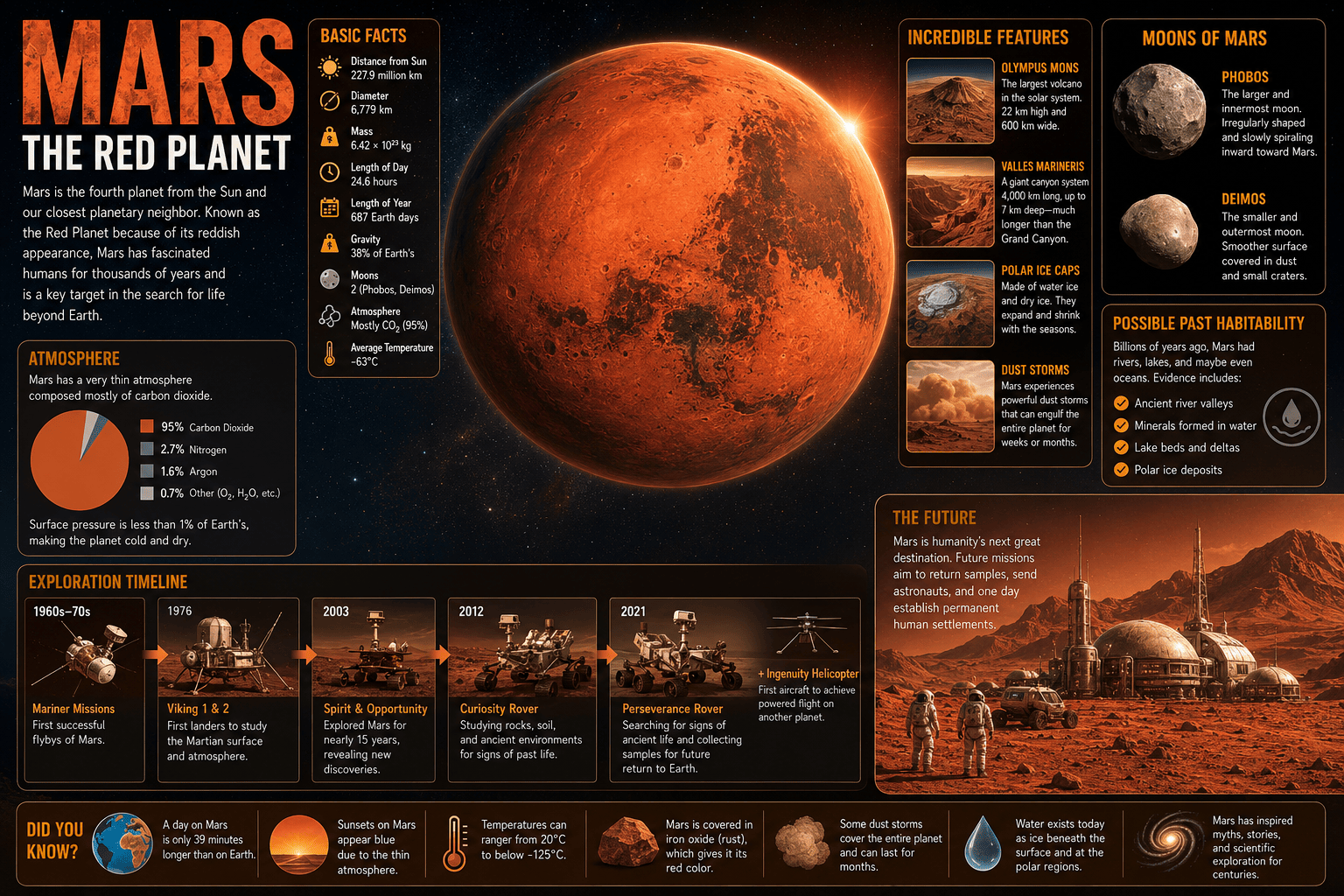
| Characteristic | Value |
|---|---|
| Distance from Sun | 227.9 million km |
| Average Distance from Earth | 225 million km |
| Diameter | 6,779 km |
| Mass | 6.42 × 10²³ kg |
| Length of Day | 24.6 hours |
| Length of Year | 687 Earth days |
| Gravity | 38% of Earth’s |
| Average Temperature | -63°C |
| Moons | 2 |
| Atmosphere | Mostly Carbon Dioxide |
A day on Mars, known as a “sol,” is remarkably similar to an Earth day, lasting just 39 minutes longer.
Why Is Mars Red?
The reddish appearance of Mars comes from iron oxide, commonly known as rust.
Billions of years ago, iron-rich rocks on the planet’s surface reacted with oxygen, creating a layer of rust-colored dust. Powerful winds distribute this fine dust across the planet, giving Mars its characteristic red hue.
This feature is visible even from Earth with small telescopes and has helped make Mars one of the most recognizable objects in the night sky.
Formation of Mars
Mars formed approximately 4.6 billion years ago alongside the rest of the solar system.
As the solar nebula collapsed under gravity, dust and gas particles collided and gradually accumulated into larger bodies called planetesimals. Through countless collisions and mergers, Mars eventually formed into a fully developed planet.
Scientists believe Mars originally possessed:
- A thicker atmosphere
- Large quantities of liquid water
- Active volcanoes
- A stronger magnetic field
Over time, many of these characteristics disappeared, transforming Mars into the cold, dry world we see today.
Internal Structure
Like Earth, Mars consists of several distinct layers.
Core
Mars has a metallic core primarily composed of iron, sulfur, and nickel.
Recent data from seismic instruments suggest the core is larger and less dense than previously believed.
Mantle
Surrounding the core is a rocky mantle.
This layer once powered volcanic activity and geological processes that shaped much of the planet’s surface.
Crust
The crust forms the outer layer of Mars.
It contains ancient impact craters, volcanic plains, valleys, and evidence of past water activity.
Unlike Earth, Mars lacks active plate tectonics.
The Martian Atmosphere
Mars has a very thin atmosphere.
Its composition is approximately:
- 95% Carbon Dioxide
- 2.7% Nitrogen
- 1.6% Argon
- Trace amounts of oxygen and water vapor
The atmospheric pressure at the surface is less than 1% of Earth’s.
As a result:
- Liquid water cannot remain stable for long
- Temperatures fluctuate dramatically
- Radiation reaches the surface more easily
Despite its thin atmosphere, Mars experiences weather phenomena such as clouds, frost, and powerful dust storms.
Surface Features
Mars possesses some of the most extraordinary geological features in the solar system.
Olympus Mons
Olympus Mons is the largest volcano known in the solar system.
It stands approximately:
- 22 kilometers high
- Nearly three times taller than Mount Everest
- About 600 kilometers wide
Its enormous size was possible because Mars lacks moving tectonic plates.
Valles Marineris
Valles Marineris is a gigantic canyon system stretching more than 4,000 kilometers.
For comparison:
- Much longer than the Grand Canyon
- Up to 7 kilometers deep
- Visible from orbit as a massive scar across the planet
Scientists believe tectonic activity and erosion contributed to its formation.
Polar Ice Caps
Mars has permanent polar ice caps composed of:
- Water ice
- Frozen carbon dioxide (dry ice)
These caps expand and contract with the seasons, providing valuable clues about Martian climate cycles.
Water on Mars
One of the most important discoveries about Mars is the evidence of past water.
Scientists have identified:
- Ancient river valleys
- Lake beds
- Delta formations
- Minerals formed in water
Billions of years ago, Mars likely possessed:
- Rivers
- Lakes
- Possibly oceans
Today, most water exists as ice beneath the surface and at the poles.
The search for water remains central to understanding whether Mars once supported life.
Martian Weather
Although Mars is cold and dry, it experiences surprisingly dynamic weather.
Dust Storms
Dust storms are among the planet’s most dramatic phenomena.
Some storms become so large that they engulf the entire planet.
These storms can:
- Last for weeks or months
- Reduce sunlight reaching the surface
- Affect rover operations
Temperature Variations
Temperatures vary widely depending on location and season.
Typical temperatures range from:
- 20°C during warm afternoons near the equator
- Below -125°C near the poles
The thin atmosphere provides little insulation.
Clouds and Frost
Mars occasionally experiences:
- Water-ice clouds
- Carbon dioxide clouds
- Frost accumulation
These features contribute to a surprisingly active climate system.
Moons of Mars
Mars has two small moons:
Phobos
Phobos is the larger moon.
Characteristics include:
- Irregular shape
- Extensive crater coverage
- Gradually moving closer to Mars
Scientists predict Phobos may eventually break apart or crash into Mars.
Deimos
Deimos is smaller and more distant.
Its smoother appearance results from accumulated dust covering many craters.
Both moons may be captured asteroids rather than objects formed alongside Mars.
Search for Life
The possibility of life on Mars remains one of science’s greatest questions.
Ancient Habitability
Evidence suggests ancient Mars possessed conditions suitable for microbial life:
- Liquid water
- Energy sources
- Essential chemical elements
These factors make Mars a prime candidate for past habitability.
Current Possibilities
Although the surface is harsh, some scientists believe microbial life could potentially survive underground where conditions are more stable.
Future missions aim to search for:
- Organic molecules
- Fossilized microorganisms
- Biosignatures
- Subsurface habitats
No definitive evidence of life has yet been discovered.
Exploration of Mars
Mars has been explored extensively by robotic missions.
Early Missions
The first successful flybys occurred during the 1960s and 1970s.
These missions revealed a cratered world that initially appeared Moon-like.
Viking Program
NASA’s Viking missions landed on Mars in 1976.
They performed:
- Surface analysis
- Biological experiments
- Atmospheric measurements
The Viking landers transformed scientific understanding of Mars.
Spirit and Opportunity
Launched in 2003, these rovers exceeded expectations dramatically.
Opportunity operated for nearly 15 years and traveled more than 45 kilometers.
Curiosity Rover
Landing in 2012, Curiosity continues studying Martian geology and habitability.
Major discoveries include:
- Ancient lake environments
- Organic compounds
- Seasonal methane variations
Perseverance Rover
Landing in 2021, Perseverance is searching for signs of ancient life and collecting rock samples for future return to Earth.
It also deployed Ingenuity, the first aircraft to achieve powered flight on another planet.
Mars and Human Exploration
Mars is considered the most realistic destination for future human settlement.
Several factors make it attractive:
- Similar day length to Earth
- Accessible water ice
- Potential resources for fuel production
- Scientific value
However, significant challenges remain.
Radiation
Without a strong magnetic field, Mars receives high levels of cosmic radiation.
Long-term exposure poses serious health risks.
Thin Atmosphere
Humans would require pressurized habitats and spacesuits.
Extreme Temperatures
Temperatures are generally far below freezing.
Distance
Travel to Mars typically takes six to nine months.
Communication delays range from 4 to 24 minutes each way.
Colonizing Mars
Many organizations are exploring concepts for permanent human settlements.
Necessary technologies include:
- Advanced life-support systems
- Food production facilities
- Water extraction technologies
- Radiation protection
- Energy generation systems
Potential energy sources include:
- Solar power
- Nuclear reactors
A Martian settlement would likely begin as a small scientific outpost before gradually expanding.
Mars in Popular Culture
Mars has inspired countless works of fiction.
Examples include:
- The War of the Worlds
- The Martian
- Total Recall
- Doom
- Red Mars
For decades, writers imagined Martian civilizations, invasions, and colonies long before scientific missions revealed the planet’s true nature.
Even today, Mars remains a symbol of exploration, adventure, and humanity’s future among the stars.
The Future of Mars Exploration
Upcoming missions aim to answer critical questions.
Sample Return Missions
Scientists hope to bring Martian rock samples to Earth for detailed laboratory analysis.
These samples could reveal evidence of:
- Ancient life
- Climate history
- Geological evolution
Human Missions
Space agencies and private companies continue developing plans for crewed missions.
Goals include:
- Scientific research
- Technology demonstration
- Preparation for long-term habitation
Many experts believe humans could reach Mars within the coming decades.
Fascinating Facts About Mars
- Mars has the tallest volcano in the solar system.
- A Martian year lasts 687 Earth days.
- Mars experiences planet-wide dust storms.
- The planet’s gravity is only 38% of Earth’s.
- Sunset on Mars appears blue rather than red.
- Mars once had flowing rivers and lakes.
- The largest canyon on Mars dwarfs the Grand Canyon.
- More than 50 missions have been launched toward Mars.
- A day on Mars is only 39 minutes longer than an Earth day.
- Mars remains the leading candidate for future human colonization.
Conclusion
Mars is one of the most fascinating worlds in our solar system. Once a potentially habitable planet with rivers, lakes, and perhaps even oceans, it has evolved into a cold desert that still holds many secrets beneath its surface.
Decades of robotic exploration have revealed evidence of water, ancient environments suitable for life, and geological wonders unlike anything found on Earth. Yet many mysteries remain unanswered, including whether life ever existed there.
As technology advances, Mars stands at the center of humanity’s ambitions for deep-space exploration. Future missions may uncover signs of ancient life, return samples to Earth, and eventually establish human settlements on the Red Planet.
More than just a neighboring world, Mars represents a bridge between our present and our future as a spacefaring civilization.